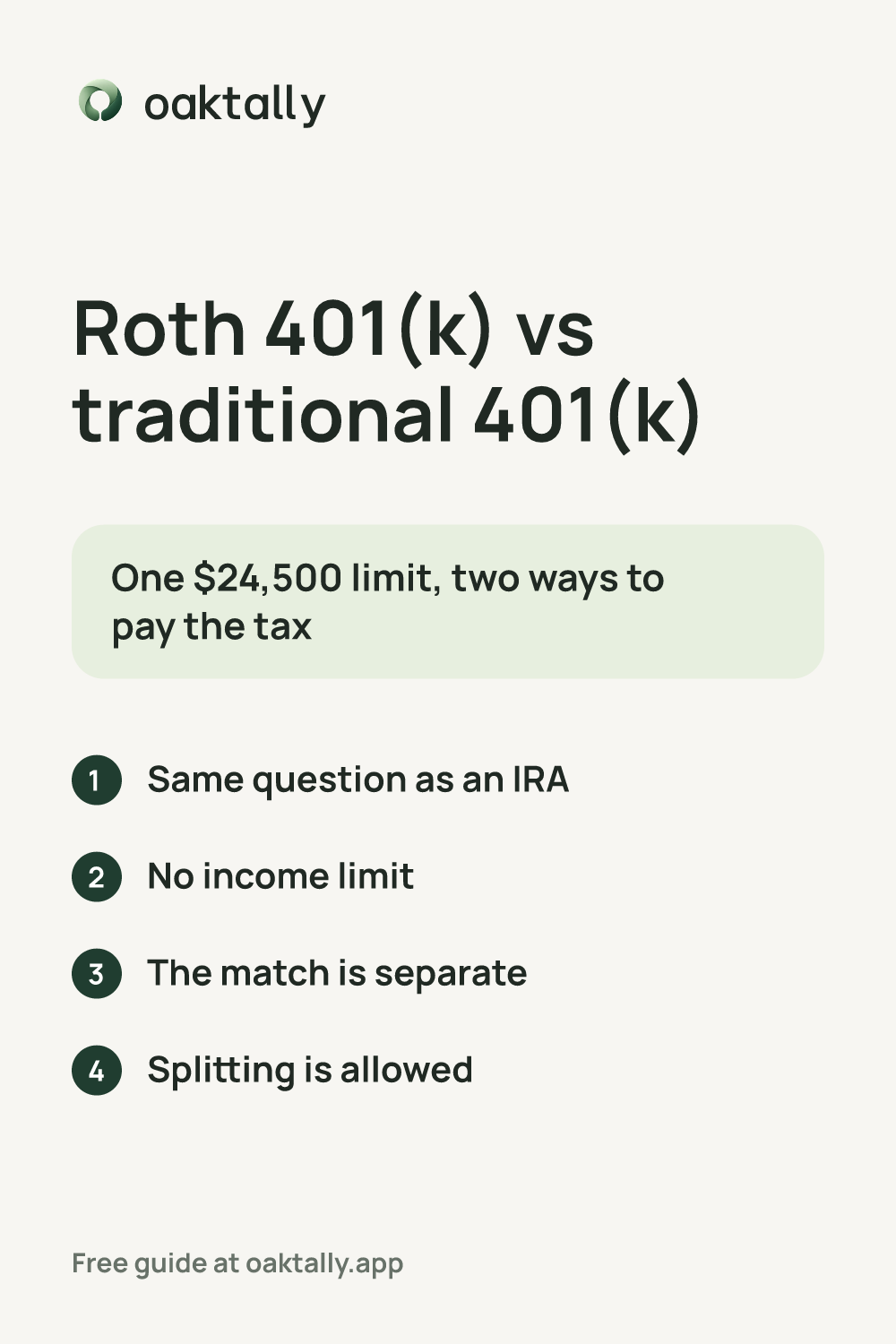

1Same question as an IRA
Pay tax now if you expect a higher rate later. Defer it if your rate is high now and likely lower in retirement.
2No income limit
Anyone in a plan that offers it can use the Roth 401(k), even if their income is too high for a Roth IRA.
3The match is separate
Your employer's match does not count toward your $24,500, and your choice of Roth or traditional does not change whether you get it.
4Splitting is allowed
Many plans let you send part of each paycheck to each, which spreads your tax bets.
5Catch-up can be Roth only
From 2026, if your wages from this employer were over $150,000 last year, any catch-up you add must go in as Roth. Your base $24,500 can still be either.
Source: IRS
How to do it in Oaktally
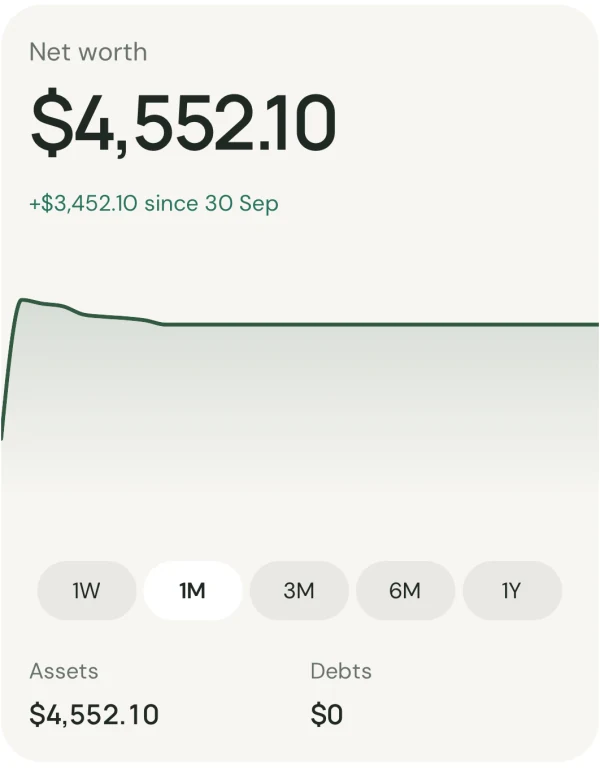
Picking Roth or traditional happens once. Seeing the balance grow next to your budget keeps you saving every month.
- Add the accountAdd your 401(k) or IRA as an investment account with its current balance.
- Update it each statementUse Update balance when your statement arrives, so the number stays current.
- See it in your net worthHome counts it with your other accounts, so you see the whole picture.
Try it with your numbers
See your balance at retirement with your match and the 2026 limit.
Run your 401(k) numbersFrequently asked questions
Does a Roth 401(k) lower my paycheck more?
Yes, slightly, because tax is taken on the money first. The trade is tax-free qualified withdrawals later.
What is the 2026 catch-up?
If your plan allows it, workers 50 and older can add $8,000, for $32,500 total. Ages 60 to 63 can add $11,250 instead, for $35,750.
Further reading
IRS: 401(k) limit increases to $24,500 for 2026, IRA limit to $7,500 ↗IRS: Retirement topics, catch-up contributions ↗IRS: Roth comparison chart ↗Educational examples, not individual financial advice.